
What is freight forwarding software?
Freight forwarding software is a category of business tools built specifically for service-based logistics companies — the freight forwarders, brokers and 3PLs who arrange cargo transport without owning trucks, ships or planes. This guide explains what it does, which modules matter and how to pick the right platform in 2026.
Victor Diaconu
Co-founder & CTO
Definition: freight forwarding software explained
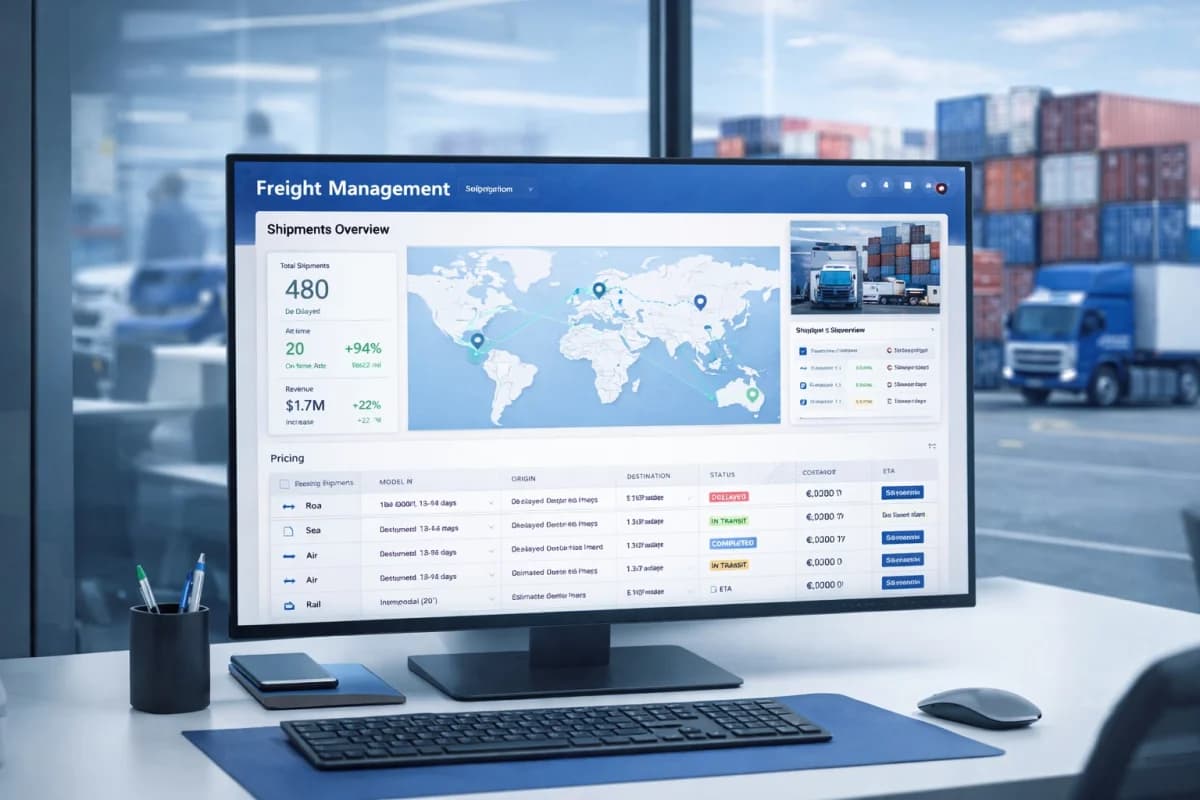
Freight forwarding software — sometimes called a freight forwarder TMS (Transport Management System) or expedition CRM — is a platform that manages the end-to-end lifecycle of a freight deal: from the first quote request to the final invoice. Unlike generic CRMs or ERPs, it understands the unique data model of forwarding: multimodal transport legs, Incoterms, carrier networks, exchange rates at customs clearance, CMR documents and per-shipment margin.
A modern freight forwarding platform typically combines three capabilities that older tools kept separate: (1) a quoting engine that handles road, sea, air, rail and intermodal in one data model, (2) a CRM that tracks clients, partners and carriers with forwarding-specific fields like truck types, operating zones and blacklist status, and (3) an operational layer that manages contracts, documents, shipment milestones and compliance.
The market has grown rapidly since 2022. According to Allied Market Research, the global freight management software market was valued at USD 18.19 billion in 2022 and is projected to reach USD 41.38 billion by 2032 — a CAGR of 8.6%. The growth is driven by cross-border trade expansion, the shift from spreadsheets to cloud platforms and the need for real-time margin visibility.
Why freight forwarders need dedicated software
Most freight forwarders start with Excel. It works for 20 offers a month. It breaks at 200. Here is what goes wrong without dedicated software:
Margin leakage — when pricing lives in spreadsheets, no one catches the offer where the buy rate was entered in USD but the sell rate assumed EUR. A freight forwarding platform locks margin at the moment of quoting and snapshots exchange rates so you see true profit per shipment.
Lost follow-ups — a generic CRM tracks 'deals' but doesn't understand that a freight deal has a quote phase, a contract phase, a loading phase and a delivery phase. Critical milestones fall through the cracks because the tool wasn't built for them.
Document chaos — CMRs arrive by email, invoices sit in a shared drive, delivery notes live in WhatsApp. A freight platform stores every document against the specific contract, flags when the set is incomplete and auto-calculates the completion date.
Carrier risk — without a vetted carrier registry, the team has no visibility into which transporters are blacklisted, which ones have capacity for Frigo or ADR shipments and which ones consistently deliver late. A forwarding platform centralises this knowledge so the whole team benefits.
Audit exposure — freight operations cross borders and currencies. Regulators expect a clear paper trail. Dedicated software logs every status change, every pricing edit and every document upload with a timestamp and user attribution.
Team dependency — when the senior sales rep who 'knows all the rates' goes on holiday, the team cannot quote accurately because the pricing history lives in that person's spreadsheet or memory. Dedicated software makes institutional knowledge accessible to everyone, so the business does not stop when one person is unavailable.
The cumulative impact of these problems is significant. A 30-person forwarding company running on spreadsheets and email typically loses 5-10% of potential revenue to inefficiency — missed follow-ups, underpriced quotes, slow response times that let competitors win the deal. Over a year, that gap can represent hundreds of thousands of euros.
Core modules of freight forwarding software
Not every platform covers every module. Here are the ones that matter most for a mid-market forwarder:
- Multimodal quoting — the ability to create offers that span road, sea, air, rail and intermodal legs in a single data model. The system should support multiple currencies, automatic FX conversion, partner quote fan-out and margin locking before the offer goes to the client.
- Contract management — once the offer is accepted, the platform should auto-generate both a client contract and a transporter contract from configurable templates. Variables like route, pricing, parties and references should populate automatically. Both signed copies should land back and flip the status.
- Client & partner CRM — separate registries for commercial partners (other forwarders) and physical transporters (carriers). Each entity should carry forwarding-specific data: truck types, operating zones, capabilities (FTL, LTL, Frigo, Container, ADR), banking details and performance history.
- Carrier network — a searchable database of vetted transporters with capability filters, blacklist functionality, contact details per driver and truck plate tracking. The whole team should see the same registry in real time.
- Shipment tracking — milestone-based monitoring from cargo loaded to trip closed. Public tracking pages that clients can open without logging in. Automatic notifications on status changes.
- Analytics & reporting — profit per shipment, revenue by client/partner/route, conversion rates, overdue payments. Real-time, not end-of-month.
- Document management — CMR, invoice, delivery note, POD uploaded against the deal. Auto-detection of document completeness.
- Email integration — sync with Microsoft 365 or Google Workspace, auto-linking emails to the relevant deal, shared team inbox with per-thread assignment.
Not every forwarder needs all eight modules on day one. A 5-person company might start with quoting, CRM and carrier management, then add contract automation and analytics as they grow. The key is that the modules share a single data model — so when you activate a new module, it works with the data you already have, without migration or re-entry. See LogiCRM pricing for module-based plans.
Cloud vs on-premise: which deployment model?
Most modern freight forwarding platforms are cloud-native SaaS products. The advantages are obvious: no servers to maintain, automatic updates, access from anywhere, and lower upfront cost. For the vast majority of small and mid-market forwarders, cloud is the right choice.
However, some enterprises — particularly those operating in jurisdictions with strict data residency requirements or those processing sensitive government cargo — prefer on-premise deployment. A good vendor will offer both options. The key questions to ask: Where are the data centres? Is the hosting EU-based? What is the data migration path if you want to switch between cloud and on-prem later?
A third option is emerging: hybrid deployment, where the core application runs in the vendor's cloud but specific data (like document storage or email archives) is kept on-premise or in the customer's own cloud tenant. This gives the convenience of SaaS with the data control of on-prem.
Regardless of deployment model, ensure the vendor provides a clear data portability guarantee. You should be able to export all your data — clients, offers, contracts, documents, communications — in standard formats (CSV, JSON, database dump) at any time. Vendor lock-in is a real risk in freight software; companies that cannot export their data find themselves paying escalating renewal fees because the switching cost is too high. A good vendor makes export easy because they are confident their product retains customers on merit, not on data captivity.
How to evaluate freight forwarding software in 2026
The market has dozens of options. Here is a practical evaluation framework:
- Does it understand freight? — Open the quoting module. Can you create a multimodal offer with road + sea legs, different currencies per leg, and a locked margin? If the vendor says 'you can customise it', that means no.
- How fast can a sales rep create an offer? — Time the demo. If it takes more than 2 minutes to go from a blank screen to a sent offer, the tool will slow your team down.
- Can you see profit per shipment in real time? — Not at month-end. Not after an accountant reconciles. Right now, on the dashboard.
- What happens when an offer is accepted? — Does the contract generate automatically? Do both parties (client and transporter) get their own document? Are variables populated from the offer?
- Email integration — Does it connect to Microsoft 365 and Google Workspace via OAuth? Does it auto-link replies to the relevant deal? Or does your team have to manually forward emails into the system?
- Carrier management — Can you search transporters by truck type, zone and capacity? Can you blacklist a carrier and have the entire team see it instantly?
- Data ownership — Can you export all your data at any time in standard formats (CSV, Excel, JSON)? What happens to your data if you cancel?
- Compliance — Is the platform GDPR-compliant? Where is the data hosted? Is there an audit log? Can you generate reports for regulators?
The best approach is to run your own real scenario through the platform. Bring a recent offer, a contract template and a set of partner quotes. If the tool can handle your actual workflow, it will work for the rest of your business.
The bottom line
Freight forwarding software is the operating system for modern expeditors. It replaces the inbox-plus-Excel workflow that worked when you had 10 clients with a platform that can scale to 1,000. The best platforms combine quoting, CRM, contract automation, shipment tracking and analytics in a single data model — so nothing is re-keyed, nothing is copy-pasted, and every deal is visible from quote to cash.
If you're still running your forwarding business on spreadsheets, the question isn't whether to switch — it's how much margin you're leaking every month while you wait. The earlier you move, the sooner you start building a data asset — every offer, every carrier rate, every client interaction captured in a structured system that compounds in value over time. Two years from now, that data will power pricing intelligence, client retention strategies and operational benchmarks that spreadsheet-based competitors simply cannot match. For a step-by-step selection process, read our guide on how to choose a TMS in 2026.