
Multimodal freight quoting: one offer for every mode
A modern freight forwarder handles road, sea, air, rail and combinations of all four — often in the same shipment. Quoting these in separate spreadsheets or single-mode tools creates data silos, pricing errors and missed margin. Here is how multimodal quoting works in a unified platform.
Ana Popescu
Product Lead
What is multimodal freight quoting?
Multimodal freight quoting is the process of creating a single offer that covers multiple transport modes within one shipment. A client needs to move cargo from a factory in Stuttgart to a warehouse in Istanbul. The optimal route might be: truck from factory to Rotterdam port (road), container ship from Rotterdam to Istanbul (sea), truck from Istanbul port to warehouse (road).
In the old world, each leg was quoted separately. The road carrier was contacted by phone. The shipping line was checked on a rate portal. The destination trucking was sourced from a local agent. The pricing was assembled in Excel, manually converting currencies and calculating a total sell price that hopefully covered all three buy rates plus a margin.
This fragmented approach creates real problems at scale. Consider a forwarder handling 150 multimodal quotes per month. If each quote involves three legs and each leg takes 10 minutes to source and price separately, that is 75 hours per month spent assembling quotes — before a single offer even reaches a client. Errors compound too: a mistyped exchange rate on one leg, a forgotten port handling fee on another, and the margin you quoted is fiction.
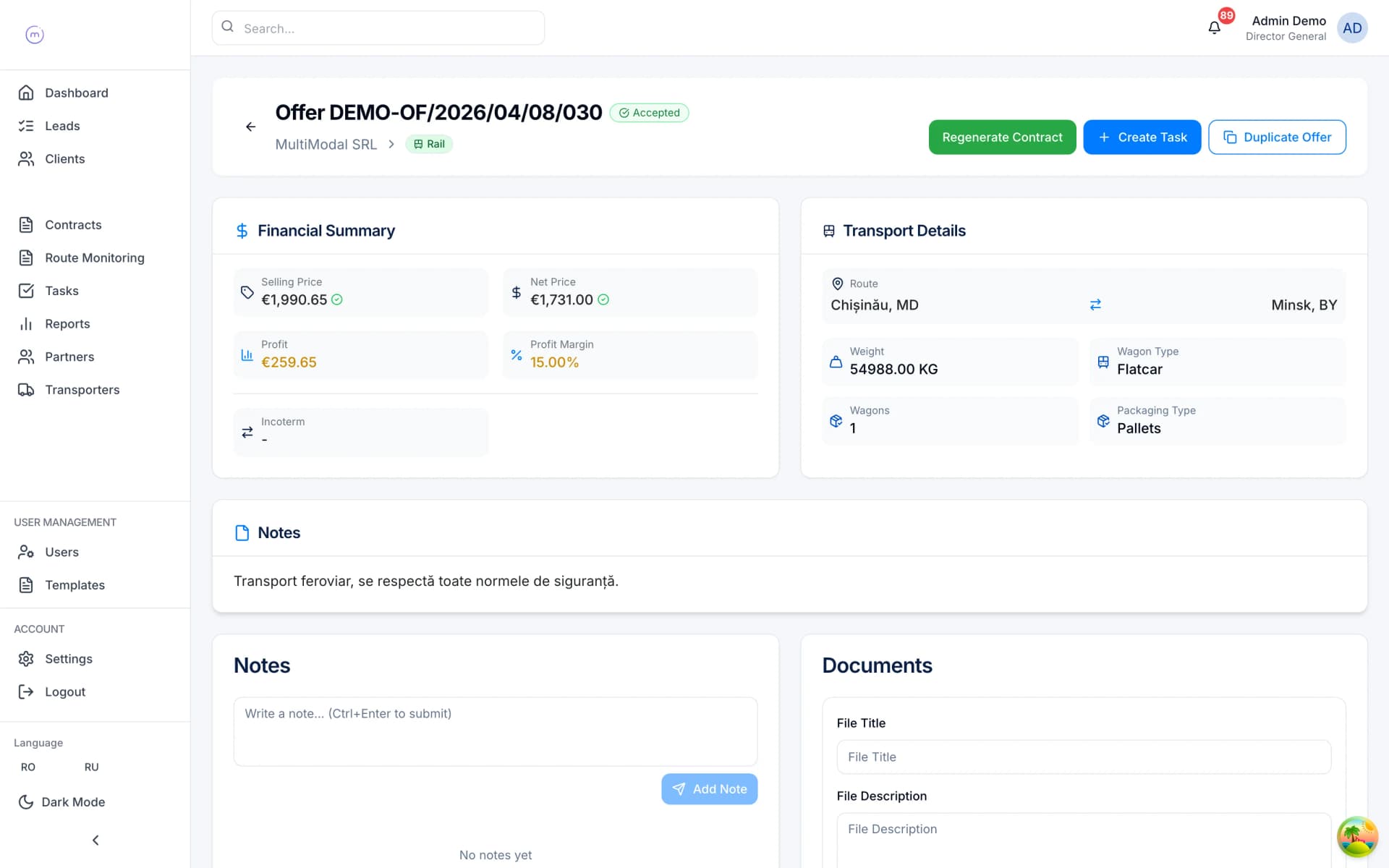
Multimodal quoting software puts all three legs into a single offer record. Each leg has its own carrier, mode, currency and pricing. The system calculates the total cost, applies the margin and generates one client-facing offer — while keeping the per-leg detail visible for operations and finance. The client sees a clean, professional quote with one total price. Your team sees the full breakdown — buy rates per leg, carrier per leg, currency per leg and the real margin after all conversions.
The efficiency gain compounds with volume. A forwarder handling 50 multimodal quotes per month who saves 20 minutes per quote by eliminating manual assembly recovers over 16 hours per month — nearly two full working days that sales reps can redirect toward client development and carrier negotiation.
The data model: legs, modes, currencies
A well-designed multimodal quoting engine uses a leg-based data model:
Offer (parent record): - Client, origin, final destination, cargo description, Incoterms, total sell price, total margin
Leg 1 (road, pre-carriage): - Mode: FTL - Origin: Stuttgart, DE - Destination: Rotterdam, NL - Carrier: TransEU GmbH - Buy rate: EUR 480
Leg 2 (sea, main carriage): - Mode: FCL 20' - Origin: Rotterdam, NL - Destination: Istanbul, TR - Carrier: MSC - Buy rate: USD 1,800 (= EUR 1,667 at snapshot rate)
Leg 3 (road, on-carriage): - Mode: FTL - Origin: Istanbul port, TR - Destination: Istanbul warehouse, TR - Carrier: AnadoluLog - Buy rate: EUR 220
Total buy: EUR 2,367 Sell price: EUR 2,900 Margin: EUR 533 (18.4%)
Each leg is independently editable. If the sea rate changes, only that leg is updated and the total recalculates automatically. If a cheaper road carrier is found for leg 3, the margin improves without touching the rest of the offer. This modularity is essential for real-world freight operations, where carrier rates shift daily and clients frequently request route modifications after the initial quote.
Partner quote fan-out: sourcing competitive rates
Most forwarders do not accept the first carrier quote they receive. Competitive sourcing is how you protect margin.
Partner quote fan-out works as follows: you create the offer with the shipment details (origin, destination, mode, cargo). Instead of manually emailing five carriers, the system generates a quote request and sends it to your selected partners from the carrier network. Each partner responds with their rate, transit time and conditions.
The quoting interface shows all partner responses side-by-side: price, transit time, carrier reputation score, previous performance on similar routes. The pricing manager accepts the best one with a click. The winning rate feeds into the offer automatically — no re-keying.
Reasons for accepting or rejecting each partner quote are logged for audit purposes. This creates a historical record of carrier competitiveness per route that informs future sourcing decisions.
Key benefit: instead of one person's relationship with one carrier determining the rate, the entire carrier network competes transparently. This typically saves 5-15% on buy rates compared to single-carrier sourcing.
Consider a practical example: a forwarder needs FTL transport from Milan to Munich. They have four carriers in their network for this lane. Without fan-out, the sales rep calls the carrier they know personally — EUR 950. With fan-out, all four carriers see the request: the quotes come back at EUR 950, EUR 880, EUR 910 and EUR 870. The winning bid saves EUR 80 per shipment. On 30 shipments per month on this lane alone, that is EUR 2,400 in monthly margin improvement — from one feature on one route.
Exchange rate handling for cross-currency offers
Multimodal shipments almost always involve multiple currencies. A European forwarder might quote in EUR, buy sea freight in USD, pay a Chinese trucker in CNY and invoice a Moldovan client in MDL.
The quoting engine needs three exchange rate capabilities:
- Automatic conversion at current rates — when a carrier quotes in USD, the system converts to EUR using the current mid-market rate so the sales rep can see the total cost in the base currency.
- Snapshot at quoting time — the exchange rate used to calculate the offer margin is frozen at the moment the offer is finalised. This is your 'expected margin' baseline.
- Snapshot at customs/invoicing time — the actual exchange rate when the shipment clears customs (or when the invoice is issued) is captured. The difference between the quoting rate and the invoicing rate is your FX impact.
A freight platform displays all three: expected margin (at quote FX), actual margin (at invoice FX) and FX impact (the difference). This gives management visibility into how much margin is lost to currency movement — and whether hedging or currency-matching strategies would help.
For forwarders operating in emerging markets — where local currency volatility can be significant — this triple-snapshot approach is not optional. A shipment quoted when USD/TRY is 32.5 and invoiced when it has moved to 33.8 represents a 4% cost shift that directly erodes margin. Without systematic FX tracking, these losses are invisible until the quarterly P&L review, by which point the damage is done and the pricing decisions that caused it are long forgotten. For a complete breakdown, see how to calculate freight margin.
Margin locking: the moment the offer is sent
Margin locking means the system calculates and freezes the expected margin at the moment the offer is sent to the client. After this point, any changes to the offer require explicit approval and create an audit trail.
Why this matters: in many forwarding companies, sales reps have the authority to adjust pricing to win deals. Without margin locking, a rep can discount an offer below the minimum margin threshold without anyone noticing until month-end.
With margin locking, the system enforces a minimum margin policy. If the rep tries to set a sell price that would produce less than the configured minimum margin (say 8%), the system warns them. A manager can override, but the override is logged.
The margin lock also serves as the baseline for variance analysis. When the deal is complete and all actual costs are known, the system compares actual margin vs locked margin. This reveals which routes, clients or carriers have the highest variance — information that directly improves future pricing accuracy.
In practice, margin locking transforms pricing discipline across the organisation. A forwarder processing 200 offers per month might discover that 15-20 offers were sent below the target margin — something invisible without a locking mechanism. Over a quarter, those underpriced deals could represent EUR 10,000-25,000 in avoidable margin erosion. The lock does not prevent flexibility; it ensures that every concession is deliberate, approved and recorded. Learn more about this workflow in our multimodal quoting solution.
From offer to contract: the handoff
The power of unified multimodal quoting is fully realised when the offer flows into a contract without manual intervention.
When the client accepts the offer, the system generates two contracts from the relevant templates:
- Client contract — a client-facing document with the agreed sell price, route, cargo details, delivery terms, payment conditions and references. Variables are populated automatically from the offer.
- Transporter contract — a carrier-facing document for each leg's winning carrier, with the agreed buy rate, pickup and delivery instructions, driver and truck requirements and references that link back to the client contract.
Both contracts get unique, auto-incremented reference numbers. Both are generated in the configured format (PDF, DOCX, Markdown). Both are stored against the deal record. When both are signed and uploaded, the status flips automatically.
This eliminates the single biggest time sink in freight forwarding: manually creating contracts from accepted offers. We cover this workflow in detail in automated contract generation for freight. In a survey of our users, contract generation dropped from 25 minutes per deal (manual process) to under 2 minutes (automated).
The operational benefit extends beyond time savings. When the contract is generated within minutes of acceptance, the carrier can be booked immediately — reducing the window during which carrier capacity might be lost to a competitor. In a market where popular lanes sell out quickly, especially during peak season, the speed from offer acceptance to carrier booking can be the difference between securing the capacity at the originally quoted rate and scrambling for a more expensive last-minute alternative.